





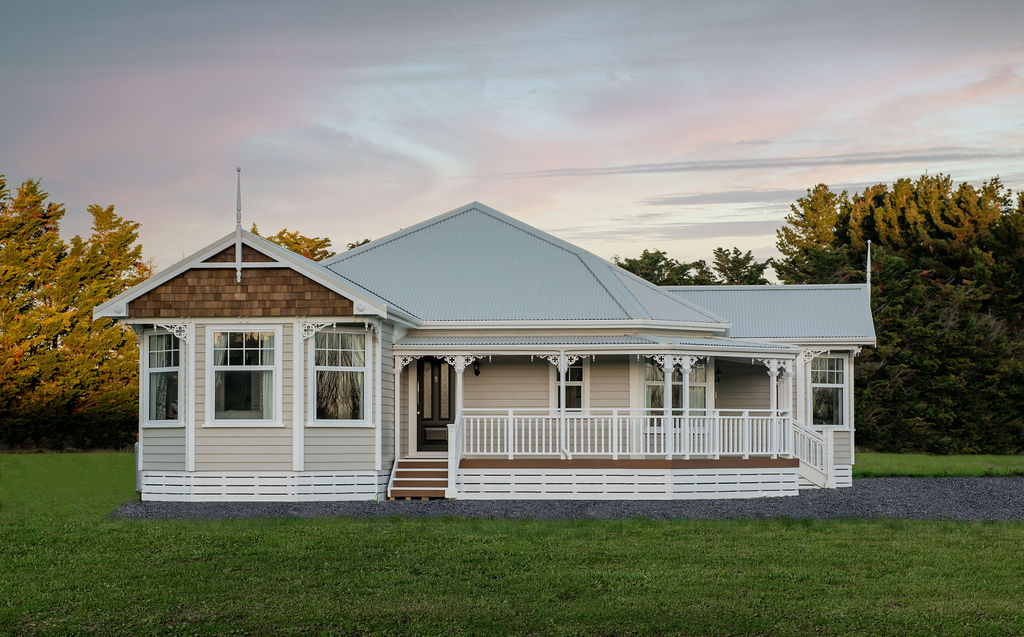
Weatherboard is what makes a character home read as one. The horizontal shadow lines of a timber board wall are the single most recognisable thing about a New Zealand villa or bungalow — and unlike stud height or window rhythm, it is a choice you make from several materials that all produce a similar look.
Here is what the options actually differ on: appearance, cost, durability, coastal performance and the painting cycle you sign up for.
Weatherboard materials compared
| Material | Character read | Practical notes |
|---|---|---|
| Timber, site-finished | The original, and the most authentic | Traditional look; needs priming and painting on all faces, and the most upkeep |
| Pre-primed timber | Effectively identical once painted | Factory-primed, faster and more consistent on site — the common choice on new character builds |
| Fibre cement weatherboard | Very close at normal viewing distance | Dimensionally stable, no borer, holds paint well; heavier to handle and cuts require dust control |
At street distance the material matters far less than the profile and the shadow line. Spend the authenticity budget on the front elevation, as set out in character home features that matter most.
Board profiles: where the period look actually lives
- Bevel-back. The classic tapered board that laps over the one below — the standard villa and bungalow profile, and the deepest shadow line.
- Rusticated. A stepped face producing a flatter, more regular wall — common on later bungalows.
- Shiplap. Tighter, more contemporary reading; used sparingly on character work.
- Board and batten. Vertical, and correct for some cottage and rural forms rather than villas.
Board width and the resulting shadow spacing do more for authenticity than the material does. Getting it wrong is the most common way a new build reads as approximate.
Cavities, coastal exposure and the specification behind the look
Two things sit behind the boards and decide how long they last.
The drained cavity. Modern weatherboard is installed over a cavity that lets any water that gets past the boards drain and the wall dry — a fundamental difference from how the originals were built, and a large part of why a new character home does not carry the weathertightness risk people associate with older housing.
Coastal exposure. Under NZS 3604, zone D — the sea spray zone — covers land within 500m of the sea and 100m of tidal estuaries. In zone D, structural fixings must be type 304 stainless steel and cladding fixings must meet higher durability requirements. It changes the specification, not the design. This catches a lot of sections on the Hibiscus Coast and through Whangārei and Northland.
What weatherboard upkeep really involves
Painted weatherboard is not maintenance-free, and anyone who tells you otherwise is selling something. Expect regular washdowns to remove salt and grime — often a condition of paint and cladding warranties — and repainting on a normal cycle, with the exposed elevations needing attention first. Coastal and high-UV sites work their paint harder than sheltered inland ones.
Against that, it is a repairable cladding: a damaged board can be replaced individually, which is not true of every modern system.
Frequently asked questions
What weatherboard should I use on a new character home?
The three common options are site-finished timber, pre-primed timber and fibre cement weatherboard. Pre-primed timber is the usual choice on new character builds because it is faster and more consistent on site while looking identical once painted. Fibre cement is dimensionally stable and holds paint well. At street distance the board profile matters more than the material.
Which weatherboard profile is correct for a villa?
Bevel-back is the classic villa and bungalow profile — a tapered board lapping over the one below, producing the deep horizontal shadow line that defines the look. Rusticated boards give a flatter, more regular wall and are common on later bungalows. Board width and shadow spacing do more for authenticity than the material choice.
Does weatherboard need a cavity behind it?
Modern weatherboard is installed over a drained cavity, which lets any water that passes the boards drain away and allows the wall to dry. It is a fundamental difference from how original villas were built, and it is central to the weathertightness performance of a new character home.
Does coastal weatherboard need special fixings?
Yes, in the higher corrosion zones. Under NZS 3604, zone D — the sea spray zone — covers land within 500 m of the sea and within 100 m of tidal estuaries and sheltered inlets. In zone D, structural fixings must be type 304 stainless steel and cladding fixings must meet higher durability requirements.
How often does weatherboard need repainting?
On a normal cycle, with exposed elevations needing attention before sheltered ones. Regular washdowns to remove salt and grime are also part of the routine and are often a condition of paint and cladding warranties. Coastal and high-UV sites are harder on paint than sheltered inland sites.
Talk to us about specifying your build
Prefer to talk? Call Heritage Homes on 0508 40 30 20 or email sales@hhomes.nz.